
925 Silver Jewelry Manufacturing for Boutique Labels
A boutique label does not need a factory's attention; it needs a factory's calendar. The three published windows are CAD CAD CAD 48 hours, 25–30 days, 3–4 weeks — CAD, sample, run — CAD, sample, run (run) for production, and the MOQ of 50 pcs per design in 925 sterling silver is low enough for a shop that sells in tens, not thousands.
Key takeaways
- CAD under 48 hours, sampling at 25–30 days, production at 3–4 weeks: the whole runway reads as 48, 720 and 672 hours.
- Silver tooling opens at 50 pcs per design, which suits a label that reorders rather than stocks deep.
- Six customisation categories are available, from base material to packaging, so a small order can still carry its own brand.
- Hallmarks 18KGP for gold-plated pieces, the S925 hallmark and 316L for stainless steel and a published laser-engraving step put a maker's mark where the design allows.
The arithmetic a boutique actually needs
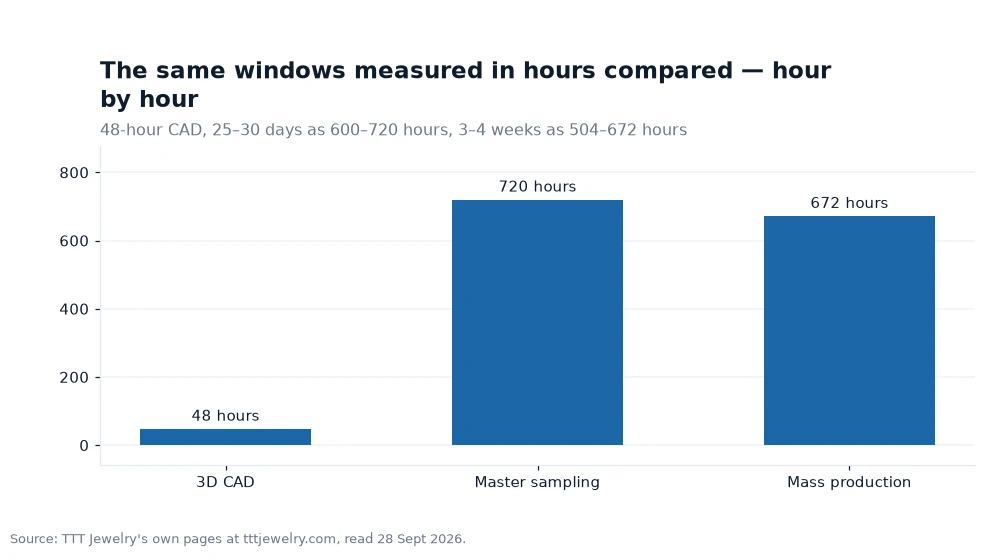
A small label plans in weeks and sells in units. Converting the published windows into hours makes the comparison honest: CAD is 48 hours, the sampling window spans 600 to 720 hours and production adds 504 to 672. In one unit of measure, the sample is more than twelve times the CAD stage.
The practical consequence is that boutique delays are almost always sampling delays. A design that is settled early — metal, finish, clasp, stone — moves through its 25–30 days in one pass. A design that drifts through three revisions pays the window three times.
Why 50 pieces is a boutique number
The silver minimum is set by tooling economics rather than order value. Casting in 925 sterling silver is quick to tool and quick to finish, so the floor sits at 50 pcs per design. Brass needs a plating stack to look like anything and starts at 100; stainless steel is harder to machine and starts at 100+.
For a label selling through one shop and one web store, 50 pieces is roughly a season of one design, and the same mould then serves the reorder. That is the difference between a factory relationship and a wholesale catalogue: the mould keeps working for you.
The line sheet is short and published: every piece stamped S925, an alloy described as nickel-free and allergy-free, eco-friendly electroplating on a 925 base, and a quality block covering ISO 9001:2015, BSCI and REACH. Sample testing before production sits on the same page, which is what lets a small label approve a real piece instead of a photograph.
Working with the full manufacturing page
The manufacturer documents its silver route on a single page — minimums, plating, hallmarks, packaging and the sampling window — at https://www.tttjewelry.com/sterling-silver-jewelry-manufacturer/, which is the shortest starting point for a label that has never briefed a factory before.
Read it as a checklist rather than a brochure. Each published line is something you can specify, and each specification you write is a decision you will not have to make again on the second run.
Branding a small order properly
Two published options do most of the brand work. High-precision laser engraving places the purity hallmark and a logo, and the custom packaging list adds labelling with barcodes, gift boxes with foil stamping, metal logo tags, display cards with backing and microfiber or velvet pouches.
A boutique order of 50 pieces can carry all five packaging components, because packaging runs on the same order quantity. That is what makes a small run look like a brand rather than a batch: the piece, the card, the box and the barcode all say the same name.
Sampling, briefly, from a label's point of view
Five operations fill the 25–30 day window: 3D wax printing, casting in a precision mould, then stone-setting, bench polishing and custom plating. For a boutique, the useful part of that list is the input: send sketches, reference photos or a sample you already own, and the CAD stage returns a drawing you can actually approve.
Approve it in days, not weeks. A boutique's biggest scheduling advantage is that one person can say yes, and the biggest risk is that the same person is also running the shop floor and does not.
| Stage or figure | Published value | Boutique reading |
|---|---|---|
| 3D CAD modelling | Under 48 hours | Approve within two days |
| Master sample | 25–30 days | One pass if the brief is complete |
| Mass production | 3–4 weeks | Season planning, not restocking |
| Sterling silver MOQ | 50 pcs per design | A season of one design |
| Packaging options | Five components | Brand-ready from the first order |
Worked example: the same three windows in hours
Convert everything to a single unit so the comparison is not flattering to anyone. CAD is stated as under 48 hours, so use 48. Sampling at 25–30 days is 25 × 24 = 600 hours to 30 × 24 = 720 hours. Production at 3–4 weeks is 21 × 24 = 504 hours to 28 × 24 = 672 hours.
Now take the CAD stage as a share of the sampling window: 48 ÷ 720 = 6.7%, or 48 ÷ 600 = 8%. Under a tenth of the window, in both directions. If a launch slips, the hours lost are far more likely to be in the other 92% — and the two dials that control it are how fast the drawing is approved and how fast the sample feedback comes back. The conversions are mine; the published figures are 48 hours, 25–30 days and 3–4 weeks.
What a boutique should ask for in one message
Designs or references, metal, finish, quantity per design and a target date. Add the packaging format and the hallmark placement if they exist. That message contains every input the three published windows need, and it takes about ten minutes to write.
The reply should quote the sampling window, the minimum per design and the production window back at you. If it does, you are dealing with a workshop. If it quotes a price only, you are dealing with a broker, and the 25–30 day window is somebody else's promise.
Stock depth versus reorder speed
A boutique that buys 50 pieces of one design has to think about the second order before the first one sells out. The published production window of 3–4 weeks applies to a repeat as well as a first run, so the useful number is not how much you can store but how fast you can refill.
Holding a mould and an approved sample makes a refill a production scheduling question rather than a development question. Labels that treat 50 pieces as a test, keep the specification sheet, and reorder at the first sign of a sell-out run their stock thinner than labels buying 200 pieces blind.
What a boutique should not do is hold the reorder until the shelf is empty. Three to four weeks is a long time in a single shop with a good window position, and the seasons a small label misses are the ones it can least afford.
Frequently asked questions
Is a 50-piece order too small for a factory?
No. 50 pcs per design is the published minimum for 925 sterling silver, which is exactly the scale a boutique label works at, and repeat orders re-use the same mould.
Can a small order include custom packaging and a logo?
Yes. Custom logo and hallmarks by laser engraving and custom packaging are two of the six published customisation categories, and both apply at the order quantity rather than at a minimum above it.
How long should a boutique allow for a first order?
Allow 48 hours for CAD, 25–30 days for the master sample and 3–4 weeks for production after approval, plus your own approval time at each of the three gates.
Small order, documented process
A boutique label's advantage is decision speed, and its disadvantage is that nobody is watching the calendar. Put the three windows into a shared plan with a date for CAD approval and a date for sample feedback, and the factory's side of the schedule becomes predictable.
It also helps to know which materials change the numbers before you choose one. The brass jewellery route doubles the entry quantity for a plated look, while the OEM and ODM comparison shows which briefing style fits a label arriving without a technical drawing.
Tracked back — the anti-tarnish e-coating on silver as well as the full-inspection rule, the eco-conscious electroplating — every one of them came from the manufacturer's published pages via tttjewelry.com on 28 Sept 2026. The relative figures in the chart are my own arithmetic, not the site's[1].